

Depending upon the size of your flock will determine how much daily feed, water, treats, roosting bars, chicken coop and run space, coop ventilation, etc. they need to remain happy, healthy, and thrive.
- Chicken Coop and Run Personal Calculators
- 1. Nesting Box Calculator
- 14 Ways to Encourage Hens to Lay Eggs Inside the Nesting Box
- 2. Chicken Roosting Bars Calculator
- Roosting Bar Calculator
- Roosting Bar Space for Adult Chickens
- 3. Chicken Coop Ventilation Calculator
- Chicken Coop Ventilation Calculator
- How to Figure Out How Much Ventilation is Needed for a Chicken Coop
- 4. Chicken Coop Size Calculator
- Chicken Coop Size Calculator
- Chicken Coop Size Calculator
- 5. Chicken Run Space Calculator
- Chicken Run Space Calculator
- Chicken Food and Water Calculators
- 6. Amount of Chicken Feed Calculator
- Chicken Feed Calculator
- 7. Chicken Table Scraps(Treats) Calculator
- Chicken Table Scraps Calculator
- 8. Number of Chicken Feeders Calculator
- Number of Chicken Feeders Calculator
- 9. Chicken Water Need Calculator (Not During Extreme Heat)
- Regular Outdoor Temperature – Chicken Water Needs Calculator
- Chicken Feeding and Watering Chart
- 10. Chicken Water Needs Calculator During HOT Weather
- Hot Weather – Chicken Water Needs Calculator
- 11. Number of Chicken Waterers Calculator
- Chicken Waterer Calculator
- Healthy Chickens Watering Tips
- Chicken Egg Incubation and Hatching Calculators
- 12. Chicken Egg Incubation Lockdown Date Calculator
- Lockdown Tips for Successful Hatch
- 13. Chicken Egg Incubation-Hatch Date Calculator
- Chicken Egg Incubation-Hatch Date Calculator
- 14. Chick Brooder Temperature Calculator
- Chick Brooder Temperature Calculator
- Signs Baby Chicks Are Too Cold or Too Hot
- 15. Chick Age Calculator
- Chick Age Calculator
- Chicken Health Calculators
- 16. Apple Cider Vinegar to Water Calculator
- Apple Cider Vinegar to Water Calculator
- 17. Chicken Comb and Wattle Signs Calculator
- What This Means
- 18. How Specific Herbs Benefit Your Chickens Health
- Herb Benefits for Chickens
- 19. What Breed Chicken Lays this Color Egg Calculator
- What Breed Chicken Lays This Color Egg?
- 20. Chicken Quantity Calculator(Chicken Math!)
- Chicken Quantity Calculator (Chicken Math!)
Take the guesswork out of caring for your chickens with our exclusive suite of 20 unique chicken care calculators.
Designed to provide tailored results specific to YOUR flock’s needs, our calculators will simplify your chicken care routine like never before.
Each chicken care calculator comes with a guide that you combine with your personal results to make raising your chickens a success.
I have broken the calculators into 4 groups:
- Chicken Coop and Run Calculators
- Food & Water Needs Calculators
- Incubation and Hatching Chicks Calculators
- Chicken Health Calculators
Chicken Coop and Run Personal Calculators

1. Nesting Box Calculator
As a general rule of thumb, you want 1 nesting box for every 3 or 4 laying hens. Use the Nesting Box Calculator below to easily see how many nesting boxes are recommended for your laying hens.
Nesting Box Calculator
| Number of Hens | Number of Nesting Boxes Needed |
|---|---|
| 0 |
How many hen nesting boxes do I need?
This is what is recommended, but most chicken owners will tell you that no matter how many nesting boxes they provide for their hens, they all will squawk over one or two nesting boxes.
I have 6 nesting boxes for 18 hens and only 3 of the boxes get used. My hens will anxiously wait in line like ladies waiting to go to the bathroom for that one special nesting box!

Providing the right number of nesting boxes is just one of many things that will help to encourage your hens to lay eggs.
14 Ways to Encourage Hens to Lay Eggs Inside the Nesting Box
| # | Methods |
|---|---|
| 1 | Add dried herbs to nesting boxes |
| 2 | Provide the right number of nesting boxes |
| 3 | Make sure the nesting boxes are the right size |
| 4 | Locate the nesting boxes in a quiet, dark place |
| 5 | Nesting boxes should be at the right level |
| 6 | Add curtains |
| 7 | Proper nesting material |
| 8 | Keep nesting boxes clean |
| 9 | Block off unwanted areas of laying |
| 10 | Keep the coop cool |
| 11 | Have nesting boxes available around 16 weeks of age |
| 12 | Don’t let hens free range until the afternoon |
| 13 | Use “fake” eggs |
| 14 | Place hen in nesting box |

2. Chicken Roosting Bars Calculator
Use the Chicken Roosting Bar Space Calculator below to see what the minimum amount of roosting space needed for your flock.
Roosting Bar Calculator
| Number of Chickens | Feet of Roosting Bars Needed |
|---|---|
| 0 ft |
How much roosting space do my chickens need?
Each adult chicken requires at least 12″ of roosting space. Make sure that you provide sufficient space for your flock to roost, otherwise they will camp out on the coop floor.
Chicken coop floors are breeding grounds for bacteria and various parasites, such as mites and lice.

So, if you have 12 adult chickens, you would need 144″ of roosting space (12 feet). This can be two, 6′ long roosting bars; three, 4′ long roosting bars; four, 3′ long roosting bars.
How Many Roosting Bars do I Need in My Chicken Coop?
Roosting Bar Space for Adult Chickens
| # Adult Chickens | Roosting Bar Space |
|---|---|
| 4 | 4 Feet – 1, 4′ Bar or 2, 2′ Bars |
| 6 | 6 Feet – 1, 6′ Bar or 2, 3′ Bars |
| 8 | 8 Feet – 2, 4′ Bars |
| 12 | 12 Feet – 2, 6′ Bars or 3, 4′ Bars or 4, 3′ Bars |
| 24 | 24 Feet – 2, 12′ Bars or 3, 8′ Bars or 4, 6′ Bars or 6, 4′ Bars or 8, 4′ Bars |
How much roosting space do adult chickens require?

3. Chicken Coop Ventilation Calculator
Enter your coops length and width into the calculator below and it will tell you the recommended square feet of ventilation.
Chicken Coop Ventilation Calculator
How much ventilation does my chicken coop need?
A chicken coop that doesn’t have proper ventilation is likely to have moisture build up inside. This causes heavy ammonia fumes, increased bacterial growth and an increased likelihood of chickens developing frost bite on their combs, wattles or feet during cold winter nights.
For the health of your chickens, it is important to provide adequate ventilation. This can be done by adding vents or mini size fans.

A chicken coop should have at least 1 square foot of ventilation for every 10 square feet of coop floor space. So, a chicken coop that is 10 feet long by 3 feet wide should have a minimum of 3 square feet of ventilation. In other words, it would need 3 vents that are 1′ x 1′.
How to Figure Out How Much Ventilation is Needed for a Chicken Coop
During the warm months, coops need more ventilation than during the cooler winter months. For increased ventilation on hot days, consider installing a coop screen door.
4. Chicken Coop Size Calculator
Chicken Coop Size Calculator
| Number of Chickens | Minimum Coop Size (Square Feet) |
|---|---|
| 0 sq ft |
Chicken Coop Size Calculator
| Number of Chickens | Minimum Coop Size (Square Feet) |
|---|---|
| 0 sq ft |
How big should my chicken coop be?
An adult size chicken needs a minimum of 4 square feet of inside coop space. Bantams require 2-3 square feet of inside coop space.
“Chickens that lack sufficient space have a difficult time or cannot carry out normal “chicken behavior,” such as pecking and scratching the ground, foraging, dust bathing and perching. This can lead to pecking of flock mates and could also lead to cannibalism. “
Why are My Chickens Pecking Each Other? 7 Important Reasons
Backyard Chickens Mama
5. Chicken Run Space Calculator
Chicken Run Space Calculator
| Number of Chickens | Minimum Chicken Run Space (Square Feet) |
|---|---|
| 0 sq ft |
How big of a chicken run do I need?
A full size chicken requires a minimum of 10 square feet of outside coop space. Bantams and younger chickens require a minimum of 8 square feet of outdoor coop space
Chicken Food and Water Calculators
6. Amount of Chicken Feed Calculator
Use the Chicken Feed Calculator below to find out how much chicken feed you should be feeding your flock each day.
Chicken Feed Calculator
| Number of Chickens | Amount of Feed Needed (cups) |
|---|---|
| 0 cups |
How much should I feed my chickens each day?
In order to raise the healthiest chickens possible, they need to be provided with about 1/2 cup of a nutritionally balanced layers feed each day. If you choose to sprout or ferment the feed, you will notice that you will not need to feed them quite as much.
Side Note: Bantam chicken breeds will eat a little bit less and the larger breed chickens, such as the Jersey Giant and Giant Cochins, will require a little bit more.
Can you give chickens too many treats?

Chicken’s love treats! After providing the appropriate amount of your flocks regular feed, it’s ok to offer them treats, in moderation.
7. Chicken Table Scraps(Treats) Calculator
Use the Chicken Table Scraps Calculator below to find out the maximum amount of treats your should be giving your chickens each day.
Chicken Table Scraps Calculator
| Number of Chickens | Maximum Amount of Table Scraps/Day (TBS) | Equivalent (Cups) |
|---|---|---|
| 0 TBS | 0 cups |
It is completely safe to feed your chickens table scraps as long as you follow these guidelines:
- Offer regular feed first.
- Table scraps should not exceed 10% of daily food intake.
- Know what foods are poisonous foods to chickens.
- Avoid sugary, salty or moldy foods.
- Consider fermenting your feed to increase the nutrient content.
Following these guidelines will result in happier, healthier and more productive chickens!
It’s important that chickens fill up with nutrients that they need the most. Most chickens will go for the table scraps first, so make sure they are finished with their main course before offering other foods.
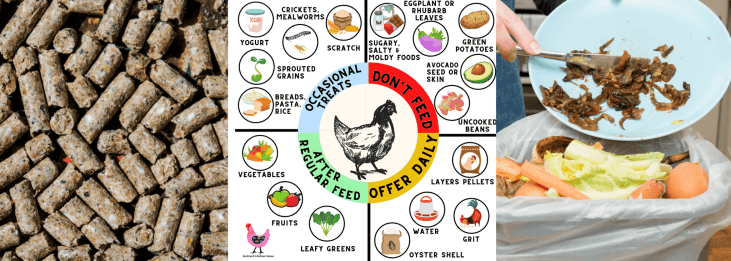
If you are looking to raise healthy chickens, just make sure that the treats don’t constitute more than 10% of their daily diet. For an adult chicken, this comes out to about 1 TBS of “treats” each day.
8. Number of Chicken Feeders Calculator
Number of Chicken Feeders Calculator
How Many Chicken Feeders Do I Need for My Flock Size?
As a general rule of thumb, it is best to provide at least one feeder per 12 chickens. Any less than this and it can create pecking and fighting as they will compete for food.
If you have overly dominant chickens, it will help to have more feeders.
9. Chicken Water Need Calculator (Not During Extreme Heat)
Use the Chicken Daily Water Needs Calculator below to see how much water you need to provide your flock each day. This is a MINIMUM.
Regular Outdoor Temperature – Chicken Water Needs Calculator
| Number of Chickens | Water Needed (Quarts) | Water Needed (Gallons) |
|---|---|---|
| 0 quarts | 0 gallons |
How much food and water do my chickens need?
The amount of food and water that you will need to give depends upon the size of your flock. Here is a good reference chart:
Chicken Feeding and Watering Chart
| # | HOW MUCH FEED/DAY | HOW MUCH WATER/DAY (Average/Hot Day) |
|---|---|---|
| 1 | 1/4 LB | 1 PINT (2 CUPS) / 2 PINTS (4 CUPS) |
| 4 | 1 LB | 1/2 GALLON / 1 GALLON |
| 6 | 1 1/2 LBS | 3/4 GALLON / 1.5 GALLONS |
| 8 | 2 LBS | 1 GALLON / 2 GALLONS |
| 12 | 3 LBS | 1.5 GALLONS / 3 GALLONS |

Provide your chickens with fresh, clean water on a daily basis. It is much better for their health. They instinctively know this and will drink more of it!
10. Chicken Water Needs Calculator During HOT Weather
Use the Hot Weather-Chicken Water Needs Calculator below to see how much water your flock needs each day during extreme heat.
Hot Weather – Chicken Water Needs Calculator
| Number of Chickens | Water Needed (Quarts) | Water Needed (Gallons) |
|---|---|---|
| 0 quarts | 0 gallons |
How much water does a chicken drink during a hot day?
Chickens will drink up to twice the amount of water during a hot day. It’s best to provide more than enough water and to have several different drinking stations.
Ideas for Making Sure Your Chickens Have Cool, Fresh Water
- Change their water frequently throughout the day.
- Have extra water sources available and put them around their coop.
- Place their water in the shade.
- Add ice cubes to their water.
- If topping their water off with the garden hose, make sure that it is cold water and not the hot water from the hose sitting out in the heat.
11. Number of Chicken Waterers Calculator
Chicken Waterer Calculator
How Many Chicken Waterers Do I Need for My Flock Size?
As a general rule of thumb, it is best to provide at least one waterer per 12 chickens. Any less than this and it can create pecking and fighting as they will compete for water.
If you have overly dominant chickens, it will help by having more than one.
If you only have one chicken waterer and it gets knocked over, your flock is left without water until you can replenish it.


Healthy Chickens Watering Tips
- Chickens should be provided with fresh, clean water on a daily basis.
- The average adult chicken will drink about 1 quart of water per day.
- During hot weather, chickens will drink up to twice the amount of water.
- During hot weather, you will need to replenish the water more frequently.
- To prevent mold and algae from forming, wash chicken waterers routinely and keep them out of the direct sun.
Chicken Egg Incubation and Hatching Calculators
12. Chicken Egg Incubation Lockdown Date Calculator
CHICKEN EGG INCUBATION LOCKDOWN DATE CALCULATOR
| Date Eggs Were Set | |
|---|---|
| Lockdown Date | – |
Visit Backyard Chickens Mama Shop
What day do you stop turning eggs in the incubator?
When hatching chicken eggs, lockdown occurs on day 18 of incubation and continues until the chicks hatch. During this time, you stop turning the eggs(or remove the automatic turner), raise the humidity level and keep the incubator closed until all the chicks have hatched.

If you see a “ring of death” during candling, you can discard them right away. The “ring of death” is a blood ring that develops when previously developing embryo dies. It is the blood vessels decomposing and forming a circle or “ring” that floats at the top of the egg.
If you are on the fence about any eggs being viable, it’s ok to wait until day 14 before discarding. But, if anything is oozing, definitely throw it out!
Use the calculator below to determine the date that you need to stop turning the eggs.
Why do You Stop Turning Chicken Eggs?
The reason that we do not rotate the eggs on day 18 is because the chicks need time to get into the proper position to hatch. By keeping the eggs still, the chicks are able to figure out which way is up and break through the shell in the right position!
Lockdown Tips for Successful Hatch
- Increase Humidity to 70-75%. This can be done by filling the secondary water reservoir in your incubator. If you still have trouble increasing the humidity, you can wet some sponges with distilled water and place them inside.
- Stop Rotating Eggs– Now is the time that the baby chick is positioning itself for hatch. You want to stop rotating the egg so the chick knows which way is up. It has a better chance of successfully hatching if it “pips” at the top of the air cell.
- Position Eggs for Hatch: You can increase your hatch rate by positioning the eggs flat, fat side slightly upward. This makes it a little easier for the chick to find the “up” position of the air cell.
- DO NOT Open Incubator: This part is one of the most difficult parts of hatching eggs. Once you enter lockdown, you must leave the incubator closed.
- Once a chick breaks through the inner membrane of an egg, if it is exposed to a quick drop in humidity, it can become shrink wrapped inside of the membrane, making it impossible to rotate within its shell to hatch.

13. Chicken Egg Incubation-Hatch Date Calculator
Using the calculator below, enter the date you set your eggs and it will tell you when you can expect to see chicks hatch!
Chicken Egg Incubation-Hatch Date Calculator
Select the date when the eggs began incubation:
| Incubation Start Date | Predicted Hatch Date |
|---|---|
| – | – |
When will my chicken eggs hatch?
Under optimal hatching conditions it takes 21 days for a chick to hatch in an incubator. If the temperature and humidity are not just right, it can cause the chicks to hatch earlier or later, but the hatch rate is not as good and the health of the chicks can be affected.
Slightly higher temperatures during incubation can cause the chick to hatch a day earlier. Slightly lower temperatures during incubation can cause the chick to hatch a day later. In both situations, the hatch rate is less and the risk of malformations is greater.

14. Chick Brooder Temperature Calculator
Use the calculator tool below to keep track of how warm your little chicks need to be.
Chick Brooder Temperature Calculator
Select the age of your chick:
| Age (Weeks) | Chick Brooder Temperature (℉) |
|---|---|
| 1 | 95 |
Keeping Baby Chicks Warm Enough
When raising baby chicks without a mama hen, it is important that you keep the brooder at the appropriate temperature until the chicks are fully feathered. Most chicks are fully feathered by 6 weeks of age.
The required brooder temperature for chicks changes week by week. For healthy and thriving baby chicks it is very important to provide the appropriate temperature.
How do I Know if My Baby Chicks are Warm Enough?
Signs Baby Chicks Are Too Cold or Too Hot
| Signs Baby Chicks Are Too Cold | Signs Baby Chicks Are Too Hot |
|---|---|
| All huddled under heat source | Panting with mouth open |
| Chirp non-stop | Are far away from heat source |
| Shivering | Lethargic (weak) |
| Eyes closed | Eyes closed |
15. Chick Age Calculator
Chick Age Calculator
Knowing the date a baby chick will be a certain age is important for several reasons:
- Diet and Nutrition: Chicks have different nutritional needs at various stages of growth. For example, very young chicks need a high-protein starter feed, while older chicks transition to a grower feed.
- Temperature Requirements: Young chicks need to be kept warm, with temperatures gradually decreasing as they age. Knowing their age helps ensure they are kept at the appropriate temperature to prevent stress and illness.
- Developmental Milestones: Monitoring a chick’s age helps track its growth and development. This includes knowing when they should start feathering, roosting, or moving to a coop.
- Vaccination and Health: Certain vaccinations and health treatments are administered at specific ages. Knowing the chick’s age ensures timely and effective disease prevention.
- Behavior and Socialization: Chicks of different ages have different social needs and behaviors. Understanding their age helps provide appropriate social interaction and care, which is especially important if integrating with older birds.
Chicken Health Calculators
16. Apple Cider Vinegar to Water Calculator
I like to add apple cider vinegar to my flocks chicken water one week out of each month. This not only is healthy for their gut, is a natural dewormer, but it also helps to keep algae growth down!
How much apple cider vinegar do I add to my chickens’ water?
Use the Apple Cider Vinegar to Water Calculator below to see how much Apple Cider Vinegar to add to your size chicken waterer.
Apple Cider Vinegar to Water Calculator
| Size of Chicken Waterer in Quarts (4 qts = 1 gallon) |
ACV Needed (Tablespoons) |
|---|---|
| 0 |
Visit Backyard Chickens Mama Shop
It’s true. Chickens will drink water that is dirty, even if it is filled with their droppings and bedding. Dirty water can contain bacteria and algae and can be harmful to your chickens.
They are more likely to contract diseases such as E. coli and Salmonella through drinking dirty chicken water.
17. Chicken Comb and Wattle Signs Calculator
What your chickens’ comb and wattle is trying to tell you….
Chicken Comb and Wattle Signs
What This Means
Visit Backyard Chickens Mama Shop
Changes in your chickens comb and wattle can tell you many things about them, including their health, sexual maturity and well being.
Everyday, take time to observe your flock so you are aware of any problems that may be going on.
The appearance of your hen or roosters comb and wattle is their way of telling you how they are doing. Listen to what they are telling you and if there is something going on, take care of it as soon as possible.
18. How Specific Herbs Benefit Your Chickens Health
Herb Benefits for Chickens
What are the benefits of giving my chickens nesting box herbs?
1. Boosts Immune System
One of the key benefits of using an herbal nesting box blend is its ability to boost the immune system of your chickens. The following herbs contain natural antimicrobial properties that can help prevent and fight off common infections:
- Rosemary
- Fennel Seed
- Chamomile
- Peppermint
- Parsley
- Marjoram
- Dandelion leaf
- Marigold
- Lavender
By exposing your chickens to these herbs on a regular basis, you can help support their immune system and keep them healthy.
2. Reduces Stress
Chickens, like any living creatures, can experience stress. This can be caused by various factors, such as changes in their environment or the presence of parasites and predators.
3. Repels Insects
Insects can be a nuisance for chickens, causing discomfort and potentially spreading diseases. Fortunately, these herbs have natural insect-repelling properties:
4. Improves Egg Quality & Quantity

The results of incorporating these natural herbs into your hens diet are the following:
- increased egg production
- better tasting eggs
- eggs that are nutritionally better for you
- thicker egg shells
- larger eggs
- deeper orange yolks
- healthier baby chicks
5. Natural Antibacterial Properties
The following nesting box herbs have natural antibacterial properties:
- Marigold
- Marjoram
- Peppermint
- Lavender
By using these herbs in the nesting boxes, you can help prevent the growth of harmful bacteria and reduce the risk of infections. This is especially important for the health and well-being of your chickens.
6. Improves Respiratory Health
One way to enhance a chickens living space is by incorporating nesting box herbs with respiratory benefits. These herbs not only add a pleasant aroma to the coop, but they also offer natural remedies for respiratory issues that chickens may face:
- Peppermint
- Lavender(loosens phlegm)
- Marjoram
- Rosemary
- Marigold(soothes mucus membranes)
When chickens inhale the aroma of these herbs, it can help improve their respiratory health and prevent respiratory issues.
19. What Breed Chicken Lays this Color Egg Calculator
What Breed Chicken Lays This Color Egg?
Fun Facts About Chicken Egg Color
Why are chicken eggs different colors?
All chicken eggs begin as white eggs. It’s the genetics of the hen that determine what color egg it will become. If an egg is any color other than pure white, pigment was deposited into it during the development.
Breed Differences: Different chicken breeds lay different colored eggs.
For example, Leghorns lay white eggs, Orpingtons lay brown eggs, and Ameraucanas lay blue eggs. Some mixed breeds, like Olive Eggers, can lay green eggs
A chicken that lays brown eggs will always lay brown eggs, but at the beginning of the laying season may be a darker color brown and fade to a lighter brown toward the end of the laying season.
This is because the hen produces more of the pigment in the beginning of the laying season!
20. Chicken Quantity Calculator(Chicken Math!)
Chicken Quantity Calculator (Chicken Math!)
| Initial Number of Chickens | Projected Number of Chickens |
|---|---|
| 0 |
Visit Backyard Chickens Mama Shop
What is Chicken Math?
Chicken math is a term used by chicken keepers to describe the often humorous and unexpected way that the number of chickens in a flock tends to grow.
It starts with a plan to get a few chickens, but due to various reasons like discovering new breeds, hatching eggs, or simply the appeal of baby chicks, the number of chickens increases more than originally intended.
Key aspects of chicken math include:
- Unexpected Additions: The initial intention might be to get 3 chickens, but soon you find yourself adding more due to impulse buys or gifts from friends.
- Lack of Self-Control: Many chicken keepers find it hard to resist adding new breeds or more chickens when they see them at a store or in a catalog.
- Rapid Multiplication: Chicken math also includes hatching eggs and raising chicks, which can quickly increase the flock size.
Chicken math highlights the often uncontrollable and exponential growth of a chicken flock due to the enthusiasm and love for keeping chickens.
But, who’s counting, right?!😂


